
Sales
How to handle fan objections in chatting: 6 replies that work
A fan objection is the moment a fan hesitates to buy: the price feels high, he wants something for free, he does not trust the offer, or he simply goes quiet. The way to handle it is not to drop the price, but to answer the real worry with the right angle: value, a little guilt, humour, a comparison, urgency or a different offer. Agencies that write these answers down, and test which ones work, close more sales without training fans to wait for discounts.
This post lists the six objections we see in creator chats every day, the six angles that answer them, and example lines you can adapt to each creator's voice.
Why do objections matter so much in chatting?
Most fans who reach the moment of an offer are interested. They opened the chat, they flirted, they asked for more. The objection is not a no; it is a question. The fan is checking whether the media is worth it, whether the creator is real, whether now is the right time.
A chatter who answers with a lower price teaches the fan one thing: push back and the price drops. The next offer gets the same objection, and the creator's whole price list loses its meaning. A chatter who answers the worry itself keeps the price, and often the fan buys more because he feels understood.
What are the six fan objections?
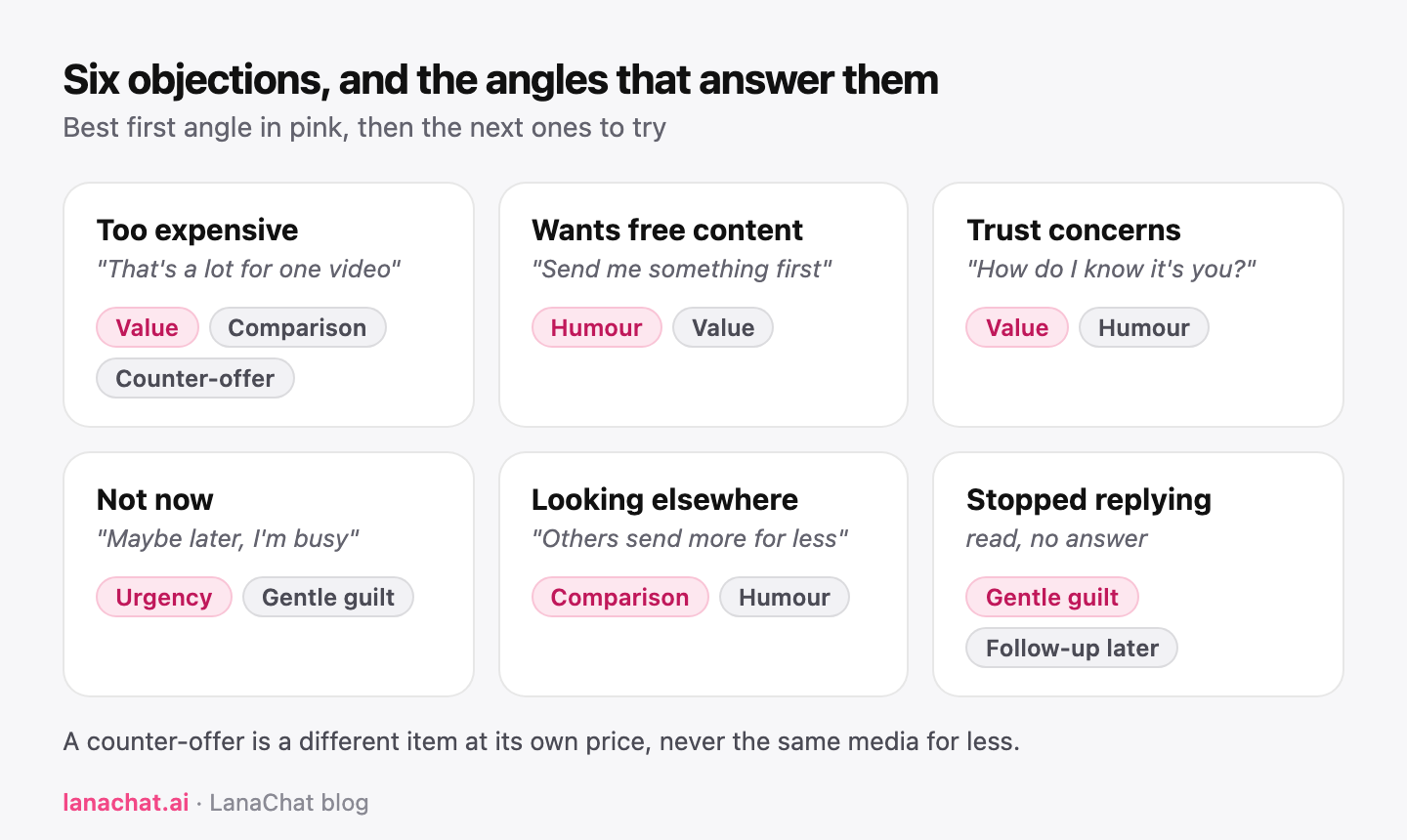
Every objection we have read in creator conversations fits into one of six kinds:
- Too expensive. "That's a lot for one video."
- Wants free content. "Send me something first."
- Trust concerns. "How do I know it's really you?"
- Not now. "Maybe later, I'm busy."
- Looking elsewhere. "Other girls send more for less."
- Stopped replying. The fan read the offer and went silent.
Naming them matters. Once your team knows which objection it faces, the reply stops being improvised.
What are the six angles that answer them?
Each objection can be answered from several angles. Here are the six we use, with an example line written the way a creator would say it.
- Value. Show what he gets, not what it costs. "It's the one I filmed for you last night, almost four minutes, I didn't send it to anyone else."
- Gentle guilt. Remind him of the effort, softly. "I spent the whole afternoon on this one, I was hoping you'd be the first to see it."
- Humour. Take the tension down. "You negotiate harder than my landlord. Still worth it though."
- Comparison. Put the price next to something familiar. "It's less than the drink you'd buy me if we met, and this one lasts longer."
- Urgency. Give a real reason to decide now. "I'm only keeping it in my private set until tonight."
- Counter-offer. Offer a different item, never the same one cheaper. "If that one's too much right now, I have a shorter one from the same shoot. Want that instead?"
Comparison works because of what psychologists call the anchoring effect: the first reference point a person hears shapes how a price feels. Use urgency only when it is true. A fan who sees the same "only tonight" every week stops believing anything the creator says.
Which angle fits which objection?
There is no single right answer, but some pairs work more often than others:
- Too expensive → Value first, then Comparison. If the fan still hesitates, a Counter-offer with a smaller item at its own price.
- Wants free content → Humour, then Value. A free teaser can be part of a script, but it is a step you planned, not a reaction to pressure.
- Trust concerns → Value, with something personal: his name, a detail he mentioned earlier. Never an argument.
- Not now → Urgency if there is a real one, otherwise Gentle guilt and a follow-up later.
- Looking elsewhere → Comparison and Humour. Do not criticize other creators; talk about what makes this one different.
- Stopped replying → a follow-up a few hours or a day later, light and without pressure. Our post on follow-up scripts that reopen silent fans has five ready to adapt.
Why should a counter-offer never be a discount?
Because the price of a media is a promise to every fan who already paid it. If the same video costs less for the fan who complained, the fans who paid full price were the losers, and the next fan learns to complain first.
A counter-offer changes the item, not the price: a shorter video, a single photo instead of a set, a smaller pack. Each one keeps its own price. In LanaChat, Lana works this way by design: she sells at the price set on the media or on the script step, and never gives discounts. See Vault and paid media for how each item gets its price, and how we price media so fans actually buy for building the ladder that makes counter-offers possible.
How do you pick the right reply every time?
Writing good replies is half the job. The other half is choosing which one to send. Two approaches work:
- Best performing. Send the reply that has converted best so far for this objection. Simple, and it improves on its own as data comes in.
- Context. Pick the reply that fits this conversation: his mood, what he said before, the time of day.
And when the first reply does not work, you need a rule for the next step: take the next reply on your list, or let the AI write its own answer. Whatever you choose, never send the same line twice to the same fan. A fan who reads the same sentence a second time knows he is talking to a script.
In LanaChat, all of this lives in the creator's AI Brain, in the Objections tab: you write replies for each of the six objections with the angle of each one, choose between Best performing and Context, set what happens when a reply does not work, and turn on Avoid repeating responses. The KYC and objections guide walks through each setting.
How do you test and improve your replies?
Treat your objection replies like ads: write several, measure, keep the winners.
- Start with two or three replies per objection, each from a different angle.
- Read real conversations every week. Look for objections that keep coming back with no sale after them.
- Rewrite the weakest reply, not all of them at once, so you know what changed.
- Keep the creator's voice. A reply that converts for one creator can sound wrong for another. Adapt the words, keep the angle.
FAQ
What is a fan objection in chatting?
It is the moment a fan hesitates before buying: the price, wanting something free, trust, timing, other creators, or silence after an offer.
Should a chatter ever lower the price to close a sale?
No. Offer a different item at its own price instead. Lowering the price teaches fans to push back on every offer.
Can an AI handle objections?
Yes, if you give it the replies and the rules. Lana uses the replies written in the creator's AI Brain, chooses by performance or by context, and avoids repeating the same line.
How many replies should I write per objection?
Start with two or three from different angles, then add more as you see what converts for each creator.
What if the fan stops replying after an offer?
Wait, then send a light follow-up without pressure. A silent fan is often busy, not lost.